Tuesday, March 14, 2006

Important Stuff to Do Right NOW from FaithfulAmerica.org

The opportunity to help END the genocide in Darfur is right before us, and the time to act is now! Several things are happening at once that could mean a breakthrough:

1) NBC News Anchor Ann Curry just returned from Darfur, and reports that the crisis is worsening. Her series on Darfur is airing THIS week on "Today" and "NBC Nightly News."

2) The U.S. House of Representatives will vote this week on an amendment to the President's emergency supplemental funding bill which would add critical funding for Darfur peacekeeping.

3) The Million Voices for Darfur Campaign has recently been launched by the Save Darfur Coalition. Its timing could not be better nor the need more urgent.

The world is waking up to the nightmare in Darfur, and we need your faithful voice as never before. Here's what we are urging you to do:

1) WATCH Ann Curry's report on Today and NBC Nightly News. Watch with people in your community of care if possible, and share this information with as many people as you can. Check your local listings for times or go HERE to read the story:
http://www.msnbc.msn.com/id/11813095 (The first installment aired yesterday.)

2) CALL! Tomrrow (March 15) is the NATIONAL CALL-IN day in support of Rep. Jesse Jackson Jr.s amendment to add $100 million for African Union peacekeepers in Darfur within the FY06 supplemental spending bill. Here's the number for the U.S. Capitol Switchboard: 202 224-3121. If you don't know the name of your Representative, you can find it here: http://www.house.gov/, A sample "talking script" is at the bottom of this letter.

3) SIGN the Million Voices for Darfur postcard campaign. Many of you have already done this (thank you!) - but we are a long way from our goal of a MILLION VOICES. Please take this final action by going here: http://www.millionvoicesfordarfur.org. Please note that you can download printable postcards for folks in your community of care.

We realize this is more complex than the simple click-to-send request, but you know more than most just how critical this issue has become. With the NBC News story, the Jackson amendment on the floor of the House, AND the collective voices of a Million Americans, we have an opportunity to move a mountain and, more importantly, save countless lives. You, as a FaithfulAmerican, can make it happen.

With deep gratitude and blessings,

Vince Isner and your FaithfulAmerica.org Team


PS; Here is a sample script to help you in your phone call to the U.S. Capitol:

Sample call script: Hi, this is [NAME] calling from [CITY/TOWN]. I'm calling to ask Congressman/woman _____ to support full funding for peacekeeping and humanitarian aid in Sudan within the supplemental appropriations bill currently under consideration.

Do you know if [HE/SHE] will support the expected Jackson amendment to add $100 million dollars for critical funding to protect the millions of innocent men, women and children in Darfur?

If yes: That's great news. Please thank [HIM/HER] for me and let [HIM/HER] know that I'll tell my friends and family that [HE'S/SHE'S] supporting this important cause.

If no, or don't know: [ONLY IF NO] Do you know why not? [EITHER WAY] Please let [HIM/HER] know that these programs are keeping millions of families alive and safe.

Please ask [HIM/HER] to do everything [HE/SHE] can to ensure that humanitarian aid life support system remains intact.

Thank you for your time.

Thursday, February 02, 2006

Prayers for Africa from the ECLA

These prayers can be used in worship or personal devotion.

Sudan - Prayer Ventures

For the church
Merciful God, we thank you for the church in Sudan. Protect the church in the midst of persecution and challenges, that it may continue to spread the Good News about your love and compassion.

For current needs
Gracious God, we pray for everyone in Sudan as they continue to strive for peace and justice. Strengthen them in their efforts and help them find ways toward reconciliation. Give comfort to those who have been displaced from homes. Give strength to those who are caught in the midst of famine and drought.

For those serving
Great and Loving God, we ask for your continuing support of the work done by relief workers, especially those representing church organizations. Help them in their work as they share the Good News of your everlasting love and forgiveness. Guide them as they work amidst difficult conditions.

For global relationships
God of compassion, we give thanks for your children all across the earth and for the opportunities we have to develop more personal relationships with our global Christian neighbors. We are grateful for the opportunity to reach out to our Sudanese brothers and sisters through prayer and communication, that we might find new meaning in these global connections. Strengthen us in that ministry and help us reach out in a mission of peace.

For church leadership
God of Wisdom, your insight and guidance fill our lives. Show us new ways to understand your power and presence within us. Thank you for the church in Sudan and for those who continue to share your message. Help those preaching and ministering to the members of the church, that they might understand and share the Holy Gospel in order to strengthen your ministry in Sudan.

For open hearts
God our Creator, you make all people part of your family. You make all that is good in our lives and fill us with your everlasting love. Bless us as we learn more about our sisters and brothers in South Africa. Help us to embrace our common blessing in serving you. Open our eyes to the gifts you give us in each other. Guide us to build bridges between our cultures and our churches. We ask these things in the name we name together, your precious Son, Jesus Christ.

UMCOR News: Sudan: Hope for Survival - Harvest and Hope Mark UMCOR’s First Year in Sudan


Long before the convoy of visitors arrived at El Ferdous, the sounds of drums, chants, and singing reached across the woodland savanna. These were the sounds of welcome in South Darfur, Sudan.

United Methodist Committee on Relief workers and representatives of Ginghamsburg United Methodist Church, Tipp City, Ohio—the congregation that has partnered with UMCOR to fund a tools and seeds program for camp residents and their hosts—were in South Darfur to meet camp and village leaders, see one of the 5,200 farms in production, and talk with residents about their experiences.

A Look-Back, One Year Later
From Jan. 26—Feb. 9, during the first anniversary of the program, UMCOR presents a series of stories about the work that United Methodists are funding in Sudan. Two stories will be featured each week.

You’ll meet Jane Ohuma, head of mission; Saba, a woman who remembers life before the war; Angelina, one of the women farming at Julha. You’ll see an innovation in camp hospitality and the bounty of the harvest.

Two stories and a photo gallery are available now:

UMCOR is working on assisting displaced people in Sudan to find their way home, to return to peaceful farming or work. United Methodists can get involved in these ministries through giving to UMCOR Advance #184385, Sudan Emergency. United Methodist Committee on Relief is a 501(c)(3) charity and all contributions are fully tax deductible. Checks may be mailed to UMCOR, PO Box 9068, New York, NY 10187-9068. Donors using a credit card may call toll free 800-554-8583.

Ohio church, UMCOR, collaborate on Sudan project

UMNS photo by Paul Jeffrey, UMCOR
Feb. 2, 2006

A UMNS Report
By Linda Bloom

What started as a Christmas offering from a United Methodist congregation to help displaced people in Sudan has turned into a five-year, multimillion-dollar project.

For the past year, Ginghamsburg United Methodist Church in Tipp City, Ohio, has been working with the United Methodist Committee on Relief to address needs in that African nation.

Since February 2003, the conflict in Darfur, Sudan, has resulted in more than 200,000 deaths and left some 3 million people homeless. The New York Times reported Jan. 28 that efforts by the United States, United Nations and European Union to end the conflict seemed to be collapsing with reports of renewed violence.

The Sudan Project began at the end of 2004, when the Rev. Mike Slaughter, senior pastor, challenged his 4,000-member congregation to contribute half of what they would normally spend on Christmas gifts to the "miracle offering" for Sudan.

With the $317,000 raised from that offering, Ginghamsburg and UMCOR established a self-sustaining agriculture program in Darfur. Through its efforts, 5,208 families have been able to start farming again, and 26,000 people in the camps are benefiting from the harvest.

Read more: here

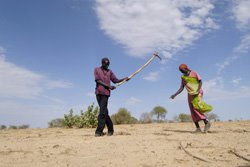
UMCOR's farm program in Sudan is 'people-driven'


A UMNS photo by Paul Jeffrey, UMCOR


Feb. 2, 2006
By Linda Beher

KHARTOUM, Sudan (UMNS) - On an August morning, Jane Ohuma points to a large map of Sudan in the Khartoum office of United Methodist Committee on Relief.

Ohuma's arm sweeps from west to east as she explains to a visitor the plight of displaced people out in Darfur, seven hundred miles from the capital city. She is head of mission for UMCOR's operations in Sudan, which began in February 2005.

Funded by a large gift from Ginghamsburg United Methodist Church in Tipp City, Ohio, and other grants, the agriculture program based in the Al Daein region of South Darfur already has crops in the ground. Some 5,200 families are working the 4-hectare farms. At an average five per family, that adds up to more than 25,000 beneficiaries.

Such a program is a bit like a puzzle. Needs and resources at a variety of levels, like interlocking puzzle pieces, must be fit together. Most importantly, Ohuma stresses, solutions to hunger and livelihoods "must address people's need and be people driven."

For example, to strengthen the local economy, UMCOR contracted with local blacksmiths to make hoes and other handheld tools for the displaced farmers, rather than purchasing them from a factory. Displaced people have no land of their own, so area landowners offered parcels of land in exchange for a portion of the sorghum, millet, cowpeas, melon, okra and peanuts.

Read more here

Friday, January 13, 2006

AU may hand over Darfur mission to UN

From CNN.com

ADDIS ABABA, Ethiopia (Reuters) -- The African Union (AU) said on Thursday it may hand over its mission in Darfur to the United Nations, saying it was running out of money for the peacekeeping operation in Sudan's troubled western region.

A report by the AU Peace and Security Council said funding for the mission -- which costs $17 million a month to maintain -- depended exclusively on the voluntary contributions by foreign partners of the 53-member body.

"At present, no commitment has been made by our partners for funding of the Mission beyond March 2006," the report obtained by Reuters said.

"The time has come to make a pronouncement on the future of the AU Mission in Darfur and the ways and means to adapt it to the present challenges, including the hand-over to the United Nations at the appropriate time," it added.

Last month Darfur rebels welcomed the prospect of the world body taking over from the AU, saying the pan-African body was doing a good job but needed more troops, help with equipment and logistics, and a wider mandate.

About 6,000 AU soldiers are trying to stop escalating violence in Darfur, a desert region the size of France, with a mandate to monitor cease-fire violations but limited powers to intervene.

Taye-Brook Zerihoun, deputy special representative for Sudan of the U.N. Secretary-General, praised the AU's work in Darfur.

"It is for the African Summit to decide and recommend to the U.N. Security Council to take over the operation in Darfur," he said, referring to an AU meeting in Khartoum on January 23-24.

"If this is done, the Security Council will consider the issue and will ask the Secretary-General to submit a report on how to proceed," he told the AU's Peace and Security Council, whose headquarters are in the Ethiopian capital.

U.N. mission

The United Nations established its Sudan mission of more than 10,000 peacekeepers and police in March last year to support a deal between Khartoum and southern rebels that ended more than two decades of civil war.

Zerihoun said the United Nations was concerned about deteriorating security in Darfur, which has seen a rise in banditry, inter-tribal clashes and armed attacks on villages and camps sheltering those fleeing the violence.

"Insecurity has also led to more instances of human rights abuse against civilians throughout Darfur," he said.

"Field missions and investigations conducted by U.N. human rights officers have continued to document violations , including forced displacements, arbitrary arrest, prolonged detention, torture and the indiscriminate use of force during military operations."

The Darfur conflict began in February 2003 when rebels launched an uprising against Khartoum, accusing the government of marginalizing the impoverished area.

The government in turn dispatched Arab militias to put down the rebellion, but they have been accused of a campaign of rape, looting and murder.

Wednesday, January 11, 2006

Seeds and Tools

SUDAN: SEEDS AND TOOLS PROGRAM YIELDS BUMPER CROP

Good rainfall, new agriculture techniques such as planting several crops together in the same plot, and adequate food to eat during the growing season have yielded a bountiful harvest in the Al Daein region of South Darfur, Sudan. With a grant from Ginghamsburg United Methodist Church, Tipp City, Ohio, UMCOR distributed seeds to some 5,200 families displaced by the Sudan war and purchased tools from local blacksmiths to strengthen the economy in the region. Peanuts, millet, sorghum, watermelon and okra were among the crops harvested during November.

Further building the economy were the activities of threshing, provided by non-farm households; packaging seed for selling at local markets; and peanut seed storage in anticipation of the next growing season. UMCOR workers led training sessions in farming techniques, market prices and seed storage. This sustainable ministry continueswith your generous donations. Please give to Sudan Emergency, UMCOR

Advance #184385. For more details, visit www.umcor.org.

Monday, December 19, 2005

Fighting Slavery in Sudan


iAbolish.com shares the remarkable story of Brent Salsgiver, who in 2002 was a student at West Virginia Wesleyan College and what he did to help free people in slavery in Sudan:

CSI's John Eibner suddenly turned to Brent and asked him to address the crowd as it waited under the tree. Brent was stunned: "I didn't know what to say, and to be honest, I don't even remember exactly what I said. What can a 21-year-old kid from Pennsylvania possibly say to people who are just emerging from the worst kind of abuse. But I told them that people in America cared about them, and that I was going to bring their stories back with me to tell the world."

Read more here.

I'm Dreaming of a Slim Christmas

Morgan Hill United Methodist Church in Morgan Hill, California is encouraging it's members to have a slim Christmas this year.

What we can do: Have a "Slim Christmas". Celebrate Jesus's birthday by giving! For example - for each dollar spent on a Christmas gift, donate a dollar to the Sudan Project. If you wish to participate in this project, please contact Pastor Ted...Let's be in prayer about how our familes can simplify Christmas this year and be part of our Sudan "Miracle Offering"!

You can learn more about Morgan Hill UMC here:

Charlottesville, VA Group Speaks Up For Sudan

Area group speaks for oppressed

By Liesel Nowak / Daily Progress staff writer
December 12, 2005

It's not easy getting news out of Darfur.

According to one refugee from the western Sudanese province, you'll need an airline ticket and a visa from the government of Sudan. From the airport in Khartoum, you must drive another three or four days if it's not the rainy season. During autumn rains, it will take a week or more to travel over mud, clay and sand.

There is no Internet access, no e-mail. A letter is likely to be confiscated by the government or its militia, the Janjaweed. Telephone use is also restricted, the refugee said, especially right before or after an attack.

Yet somehow, an organization based in Charlottesville is learning about human rights abuses in the remote region and helping spread the word to the world in an effort to stop a humanitarian disaster.

"It's the only voice for those voiceless for over a decade," said Mohamed A. Yahya, executive director of Damanga Coalition for Freedom and Democracy. "Because our reports are the only available sources ? it is used by different authorities as standards and references, even for researchers, students and those individuals concerned around the world."

Damanga formed from the human rights group Representatives of the Massaleit Community in Exile, or RMCE, which was founded in 1995 to alert the world of the abuses unfolding in Western Sudan.

Over the past two years, a crisis has unfolded in Darfur with reports of ethnic cleansing, forced displacement of 2 million civilians, the bombing and burning of villages, the raping of women and the murder of 70,000 Darfurians.

The Sudanese armed forces and government-trained Janjaweed militia are charged with carrying out the atrocities.

Yahya was a student in Egypt in 1993 when he, fellow students and Darfurians based in Cairo mobilized to create the RMCE. He had just learned that his village was one of 50 burned and destroyed in only two days.

"They killed thousands of innocent, [unarmed] people, indiscriminately, and threw kids in the fire of burning huts," Yahya said.

Among the dead, he said, were 17 relatives, including his two grandfathers.

"From that time, I realized that action must be taken," Yahya said. "I held an urgent meeting with over 50 Darfurians and students in Cairo, and decided to do something to protect our people. So we collected some money from our own poor pockets and sent them to Darfur victims."

Once off the ground, the RMCE started to spread the word through Arabic and English newspapers, letters to foreign embassies, the Internet and conferences.

Yahya said he was the first student to be blacklisted and eventually exiled from Egypt. Unable to return to Darfur, Yahya came to live in the United States, thanks to political asylum.

Though the organization began without funding, Damanga has grown to accept donations from all over the world, including a $50,000 grant recently awarded by the Philanthropic Collaborative, an organization with ties to the Rockefeller family.

"We are very proud and grateful for this wonderful and generous help," he said, "that would absolutely help us push our work forward and support our innocent people in Darfur and everywhere."

Wednesday, December 14, 2005

Hurdles Cited in the Investigation of Darfur Crimes

From Morning Edition, December 14, 2005:

Michele Kelemen reports that the main prosecutor for the newly created International Criminal Court told U.N. Security Council Wednesday that the security situation in Darfur has made his job difficult. The Security Council referred the Sudan atrocities investigation to the ICC nine months ago.

There is audio of this report on the site. Just click on the "Listen" link.

Thursday, December 01, 2005

We Shout Louder When We Shout Together

From Al Thorne, Pastor of Asbury Memorial United Methodist Church in Chesterfield, VA:

We are partnering with Ginghamsburg UMC and UMCOR following their lead last Christmas and receiving and offering. We are asking our congregation to have a slim Christmas and give the same amount to relief as we give to ourselves and friends at Christmas. We will be showing a video to the congregation in the next two weeks produced by Ginghamsburg.

See www.ginghamsburg.org and click on Sudan Project for the inspiring story.

Tuesday, November 29, 2005

The Lost Boys of Sudan

Chester United Methodist Church has a fund for the Lost Boys. We have sent them well over $2,000 for school expenses and more recently for their trip back to Sudan. There are about 21 Lost Boys returning to Sudan to see families they have not seen for as much as 17 years. This is a much needed visit as they come out of a survival mode and begin to build a life and new purpose for themselves and their native land, Sudan.

If anyone would like to give a financial gift to this please send it to Chester UMC, 12132 Percival Street, Chester, VA 23831. Make the check out to Chester UMC with a memo "Sudan Lost Boys". They pretty much have their travel expenses paid for (an amazing accomplishment considering the low-paying jobs they have while they are paying their way through college) but will need more to pay their bills (rent, utilities, car insurance, etc.) upon their return. Their jobs do not have vacation time so they will be without pay during those weeks back home.

Sudan accuses Chad of violations

From the BBC:

Sudan has accused neighbouring Chad of violating its airspace and supporting rebels in its western Darfur region.

A Sudanese foreign ministry statement said Chadian airplanes had flown over Sudanese territory without permission on two occasions earlier this month.

Chadian troops allegedly crossed the border several times, stealing cattle.

Chad denies the accusations and last week accused Sudan of using Chadian deserters to fight rebels in Darfur.

In its statement, the Sudanese foreign ministry also accused an unnamed third country of shipping arms and munition to rebels in Darfur.

In an interview with the BBC, Chadian Information Minister Hourmadji Moussa Ndoumgor earlier said Sudan was trying to destabilise his country.

Chadian troops mutinied from their army in September this year and claim to number in the hundreds. They say they want to overthrow their president.

According to Sudan, the Chadians number about 120.

"The weapons they [Sudan's government] are giving to the deserters to fight the Darfur rebels could in the future be used against our government," Mr Ndoumgor told BBC Afrique.

The long border between Sudan and its western neighbour is porous, with a murky mix of rebel groups and armed militia roaming its arid landscape.

The same ethnic groups are found on both sides of the border.

A ceasefire is supposed to be in place in Darfur but the Sudanese army, pro-government Arab militias and black African rebel movements have broken it with regularity.

Some 2m people have fled the conflict in Darfur, with more than 100,000 crossing the border into Chad.

Saturday, November 12, 2005

The Shame of Darfur

From The Other Journal:

The calculated savagery of Khartoum’s campaign has been stunning. As Nicholas Kristof of the New York Times reported in February, a document seized by the African Union from a Janjaweed official outlined in chilling detail official government policy. Demanding “execution of all directives from the president of the Republic,” it called upon commanders to “change the demography of Darfur and make it devoid of African tribes.” Dated August 2004, the document encouraged “killing, burning villages and farms, terrorizing people, confiscating property from members of African tribes and forcing them from Darfur.”


Terribly effective, this strategy resulted in near-total ethnic cleansing in the areas in which it occurred, leaving over two and a half million people bereft of sustenance and vulnerable to continuing attacks, with the lives of even more at risk. The only reason violence has abated recently, as noted by Andrew Natsios, head of the U.S. Agency for International Development, is that “there are not many villages left to burn down and destroy.”

Read the rest of the article here:

Tuesday, October 11, 2005

Turning Suffering into Art

Fresh Air from WHYY, October 10, 2005 · Rapper Emmanuel Jal was one of the "Lost Boys" -- youths caught up in violence in Sudan. He later escaped to Kenya. Now he's making music about peace.

Jal's new CD, Ceasefire, pairs him with Abdel Gadir Salim, a celebrated singer and musician from northern Sudan. Their music reflects the juxtapositions found in many parts of the world: Christian and Muslim; modern and traditional.

The project -- a rare collaboration between musicians from southern Sudan and its north -- is one close to Jal's heart. By the age of 8, he was carrying a gun as a conscripted soldier in the Sudan People's Liberation Army. Only with the help of his adoptive British mother did he manage to get away from the violence.

Jal, who converted to Christianity after leaving Sudan, has also lived in Great Britain -- where he solidified his love for hip-hop. In addition to his music career, Jal works with the Campaign to Stop the Use of Child Soldiers.

The audio interview is archived online. Jal's hip-hop is truly remarkable, mixing great world beats with a message of love, peace, and hope.

Tuesday, September 27, 2005

Sudan: A Recollection of Peace

In quiet Arabic Saba recounted her story of life before the war to a visitor at the office of United Methodist Committee on Relief. She meant before men on horseback plundered and shot up rural Zallingi in West Darfur, Sudan, her home from girlhood. After losing all they had, some of Saba's family fled east and south on foot, and by lorry when they were lucky. Decades of war have displaced millions like Saba--at the United Nations some say as many as four million, the largest number of internally displaced people in the world.

Since February 2005, the United Methodist Committee on Relief (UMCOR) has implemented agriculture programs in South Darfur, helping people like Saba's family to regain their self sufficiency. UMCOR is also working on assisting displaced people in Sudan to find their way home, to return to peaceful farming or work.

United Methodists (and others) can get involved in these ministries through giving to UMCOR Advance #184385, Sudan Emergency. Mail your checks to:

UMCOR
PO Box 9068
New York, NY 10087-9068

Remember, as always, 100 percent of your giving to UMCOR goes to the people in need.

Thursday, August 11, 2005

Send Me Your Shouts

Please feel free to send me your ideas, what your church or organization is doing for Sudan. Anything from your personal prayer life to something big and organized. You never how your ideas might spark someone else's creativity and get them involved. Please send your submissions to
shoutLOUDnow@gmail.com

Worship Resource

Here is a great worship resource (PDF, Adobe Acrobat required)from Catholic Relief Services. This resource can be easily adapted to fit any number of Christan denominations and is perfect to use in worship to help make your congregation aware of the need to pray for Sudan.

Shout With Others

Here is an online petition that comes from Faithful America and Africa Action. They are trying to gain 400,000 signatures.

This is a simple way to get involved, plus you can e-mail the link to family and friends and get them involved.

Thursday, August 04, 2005

A Somewhat Less Easy Way to SHOUT

Last summer, my brother convinced me to train for the Richmond Marathon. As I was preparing for it, I ran a couple of half-marathons. I had an idea to get people I knew to sponsor me per mile for one of the 13.1 mile runs.

I was able to raise about $100 per mile, which I gave to UMCOR's work with refugees.

All in all, I was able to get in shape, have a lot of fun, and help people in need. If you are looking for motivation to start an excercise program, this could be it.

Runners' World has a feature at their site that allows you to find races in your area. You can start with short races like a 5k (3.1 miles) and walk it if you want. Races are fun, social events for all ages, and you get a t-shirt!

Tuesday, August 02, 2005

Take Action (How to SHOUT)

Here are some easy ways you can make a difference in Sudan:

UMCOR

Support the United Methodist Committee on Relief Sudan Emergency Advance #184385. Funds given here provide help to Sudanese refugees fleeing into neighboing Chad. One hundred percent of what you give goes to people in need. No kidding. No messing around. No relief organization on earth can make a better promise.

That local United Methodist congregation in your neighborhood has already helped pay the all the administrative costs of UMCOR's work.


Amnesty International

Amnesty provides an "activist toolkit" that can be downloaded (some items require the free Adobe Acrobat Reader, found at www.adobe.com). This toolkit includes posters, stickers, and ways to get involved locally.


Write your Senator or Member of Congress
The late Senator Paul Simon once famously remarked that

"If every member of the House and Senate had received 100 letters from people back home saying we have to do something about Rwanda, when the crisis was first developing, then I think the response would have been different."

For a mere fifteen minutes of time and a thirty seven cent stamp, you can change the world. You can find the name and address of your representatives using the links on the right of this page.

These are great projects for women's groups, men's groups, and youth groups. Using the information found here, you can put together a presentation and then offer your people the above opportunities as ways to take action.

Sudan: Learning the Basics

Here (the link above) is an easy way to learn some basic information regarding the history and background of the conflict in Darfur. Includes pictures.


From Amnesty International.

Mission Agency Calls for Prayers that Peace Will Survive a Sudanese Leader’s Death


General Board of Global Ministries,
The United Methodist Church

475 Riverside Drive,
New York, NY 10115

Contact: Elliott Wright
Tel: 212/870-3921
email: ewright@gbgm-umc.


From the United Methodst News Service

NEW YORK, NY, August 1, 2005—The international mission agency of The United Methodist Church today called for prayers that a peace agreement in southern Sudan will hold in the wake of the death of one of its principal architects.

“Let us pray that the peace accord will be respected despite this great tragedy,” said the Rev. R. Randy Day, chief executive of the General Board of Global Ministries.

Dr. John Garang, 60, the U.S.-educated leader of the Sudan Peoples’ Liberation Army, who had become the first vice president of Sudan only three weeks ago, was killed in a helicopter crash late on Saturday, July 30, as he returned from a trip to Uganda. In January, 2005, the peace agreement forged between the north and the south in Sudan ended the longest running civil war in Africa. Some 1.5 million people were killed.

“We watch developments in southern Sudan carefully because of the protracted conflict there and because we have about a dozen congregations in the area,” Day said. “We are also praying for the peace and prosperity of all the people of Sudan.”

The mission board’s call for prayers came partly in responded to a plea from Angelo Maker, who was one of the thousands of “lost boys of Sudan.” In the 1990s, these children and teenagers walked hundreds of miles to escape the turmoil in southern Sudan, going first to Ethiopia, back to Sudan, and then to Kenya. The United States agreed to accept 3,000 of the “boys,” 52 of whom were resettled by the United Methodist Committee on Relief (UMCOR) in 2001 and 2002.

Mr. Maker is now a student and attends a United Methodist church in Virginia. He was a guest at the Western Pennsylvania Annual Conference last June.

“The situation in southern Sudan is very critical,” he said in his e-mail, that encouraged people to pray that the peace accord will hold steady.
The conflict in southern Sudan is distinct from that in Darfur, a western region of the vast country where UMCOR provides humanitarian services to displaced people.

Appeals to respect the peace in the south were also made by the New Sudan Council of Churches, the Sudan Catholic Bishop’s Conference, and the All African Conference of Churches. Dr. Mvume Dandala, a South African Methodist who leads the latter organization, issued a statement calling upon “the people of Sudan to be calm and demonstrate that commitment to peace that Dr. Garang had wished for when he signed the peace agreement.”

John Garang was a member of the southern Dinka ethnic group and was from a Christian family. A member of the Anglican Church, he was graduated in 1969 from Grinnell College, a school with Congregationalist church roots in Iowa. He also received military training at Fort Benning, Georgia. The Christian population of Sudan is concentrated in the south.

Monday, August 01, 2005

Darfur Violence Through the Eyes of Children

Darfur Violence Through the Eyes of Children

by

From NPR and Human Rights Watch

A Sudanese child's drawing shows men on a camel firing their weapons. Dr. Annie Sparrow/Human Rights Watch

This drawing shows a helicopter and plane attacking a village in Darfur. Dr. Annie Sparrow/Human Rights Watch

Morning Edition, August 1, 2005 · Earlier this year, aid workers at a refugee camp in Chad, on Sudan's western border, passed out crayons and paper to children while Human Rights Watch officials interviewed their parents. Without prompting or instruction, the young artists put pen to paper and produced some harrowing images -- the visions of an unfolding genocide in Sudan's Darfur region.

Minky Worden, the media director at Human Rights Watch in New York, describes one of the pictures: "You see the government helicopters bombing the villages. You see armored personnel carriers rolling into the villages… And the amazing thing about this drawing is the ability of this child, age 13 or so, to make stick figures show absolute terror."

Some of the drawings, made by children aged 8 to 17, are on exhibit at New York University's Edgar Bronfman Center through Labor Day, the first stop in a national tour.

Saturday, July 30, 2005

About me

My name is Doug Forrester and I am the pastor of

Crozet United Methodist Church in Crozet Virginia.

The purpose of this site is to give churches, individuals, and other organizations simple ways to learn about and get involved bringing positive change to the people of Sudan.

Raise your voice. You can make a difference.

Where you live should not decide
whether you live or whether you die.
-U2, "Crumbs From Your Table"